Lock USB Port or Disable It? Best Way to Secure Devices in 2026


(Lock USB Port)
While organizations invest heavily in firewalls and endpoint software, USB ports remain one of the most exploited physical entry points.
Should you disable USB ports with software—or physically lock USB ports for real protection?
Table of Contents
Why Lock USB Port Are a High‑Risk Entry Point
USB ports are designed for convenience, but that same convenience creates risk.
Transfer sensitive data without leaving network traces
Introduce malware that bypasses firewalls
Steal data in seconds
The issue is not detection—it is uncontrolled access.
Disable USB Ports (Software‑Based Control)
When disabling USB ports helps
- Centralized policy enforcement
- Managing large device fleets remotely
- Reducing casual or accidental USB usage
Where disabling USB ports fails
- Can be overridden by users with admin access
- Vulnerable to policy changes or OS reinstalls
- No visible deterrent—users still attempt access
- Does not physically block device insertion
Disabling USB ports improves control—but it does not eliminate risk.
Lock USB Port (Physical Security Control)
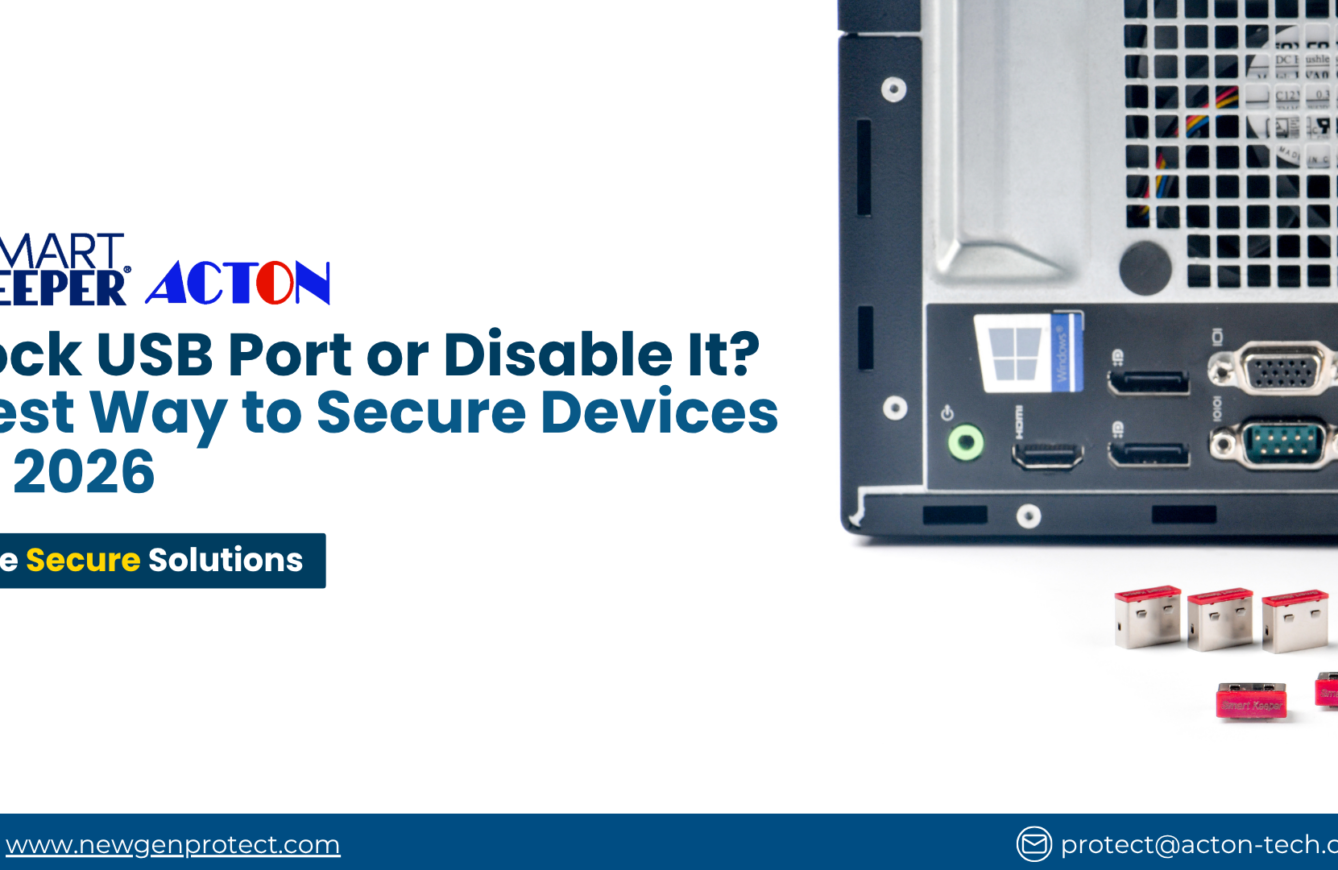
To fully close the gap, organizations increasingly choose to lock USB ports physically. A USB port lock blocks the port itself—making access impossible without authorization.
Why locking USB ports is more secure
- Completely prevents device insertion
- Cannot be bypassed by software or remote access
- Acts as a visible deterrent to misuse
- Works independently of OS or system policies
If nothing can be plugged in, nothing can attack through that port.
Lock USB Port vs Disable USB Port: Which Is Better?
Method
Disable USB port (software)
Lock USB port (physical)
Level of Protection
Moderate
High
Best practice: use software controls for policy management—and lock USB ports for enforcement.
What Happens If Lock USB Port Are Left Unsecured?
Data breaches and IP theft
Malware infections spreading across networks
Costly downtime and reputational damage
In many cases, breaches aren’t sophisticated—they happen because a USB port was left open.
Why Organizations Choose to Lock USB Port
Strong endpoint protection without complex systems
Reduced insider‑threat exposure
Clear, enforceable security policies
Lock USB Port Key Features and Capabilities
Stops unauthorized devices at the source
Only authorized personnel can unlock ports
No software, drivers, or system changes
Works on desktops, laptops, and shared devices
Why Buy Lock USB Port SmartKeeper from Acton
Authorized distributor of Smartkeeper
As an authorized SmartKeeper distributor, Acton delivers more than just hardware. You gain access to genuine SmartKeeper products, along with expert recommendations tailored to your specific use case. With local consultation and reliable after-sales support, Acton ensures a smooth and effective deployment. You’re not just locking USB ports—you’re strengthening your overall endpoint security.
Don’t Just Disable—Lock USB Port
Disabling USB ports is a good start.
But if you want real, enforceable protection:
Lock USB ports physically.
Because in cybersecurity, the smallest ports often create the biggest breaches.
FAQs
Locking a USB port means inserting a physical lock that blocks device access. The port can only be reopened using a dedicated key.
Yes. Locking USB ports provides physical enforcement that software alone cannot bypass.
No. USB port locks work best as part of a layered security strategy alongside endpoint and network controls.
Yes. SmartKeeper USB port locks install in seconds with no technical setup.
- Post date: March 26, 2026
- 312 Views
- 0 Comments
USB Lock: Where Insider Data Theft Starts
(USB Lock)
Most insider data breaches don’t start with hackers—they start with a USB port.
An unlocked USB port allows files to be copied, malware to be introduced, and security policies to be bypassed in seconds—often without triggering any alerts. No firewall, antivirus, or endpoint tool can stop what happens once physical access is already granted.
Table of Contents
Why Insider Threats Are Harder to Stop Than External Attacks
Insider threats are dangerous because they don’t look like attacks.
Employees, contractors, and visitors already have proximity to devices, which means their actions rarely raise red flags. Whether intentional or accidental, a single USB connection can compromise sensitive systems.
Most insider incidents follow the same few patterns
Once a USB port is exposed, organizations face recurring risks:
Unauthorized data copying
Malware introduced through trusted access
Bypassing security controls without resistance
The issue is not detection—it is uncontrolled access.
Why Endpoint Security Alone Is Not Enough
Endpoint security reacts after a device connects
Antivirus, EDR, and DLP solutions are built to monitor behavior and respond to threats, but they do so only once a USB device is already recognized by the system.
A USB lock prevents the risk before it exists
By physically blocking the port, a USB lock stops unauthorized devices from connecting at all—removing the need for alerts, scans, or incident response.
This physical layer of protection delivers practical advantages:
Prevents access at the source
Reduces malware exposure instantly
Strengthens compliance and audit readiness
Together, endpoint software and a USB lock create a true defense‑in‑depth strategy.
Where USB Lock Deliver the Most Value
Not all endpoints carry the same level of risk.
These are most impactful in environments where access changes frequently or devices are shared.
Shared and public‑facing devices
Meeting rooms, training rooms, kiosks, and hot‑desking setups where hardware is used by multiple people.
Endpoints handling sensitive or regulated information
Systems in finance, healthcare, education, and government environments where data leakage carries serious consequences.
High‑turnover workplaces
Contractor‑heavy or seasonal environments where users need system access but should not extract data.
Key Features and Capabilities
Why Organizations Choose SmartKeeper USB Lock
Authorized distributor of Smartkeeper
to deter forced removal
including laptops and desktops
without software installation, power, or maintenance
As an authorized distributor of SmartKeeper products, Acton provides organizations with access to reliable physical cybersecurity solutions designed to protect endpoints from insider threats and unauthorized access.
By partnering with Acton, organizations gain not only authentic, enterprise-grade USB locks but also professional guidance for selecting and deploying the right solutions. Acton’s local expertise ensures that SmartKeeper products integrate seamlessly with existing endpoint security systems, creating a comprehensive, layered defense strategy.
With Acton, companies benefit from both high-quality physical security technology and the support needed to implement it effectively across their organization, safeguarding sensitive data and maintaining compliance with security standards.
USB Lock: Prevention Starts with Physical Security
You cannot secure data if you cannot secure access points.
Software tools help detect and respond to threats, but physical security ensures those threats never gain entry in the first place.
A USB lock is a small, deliberate investment that closes a major insider‑threat gap. By physically controlling USB access, organizations reduce data‑theft risks, strengthen compliance posture, and protect endpoints where software alone falls short.
For organizations in Singapore and beyond, Acton delivers SmartKeeper USB lock solutions that help secure critical endpoints and safeguard sensitive data—before incidents occur.
Contact protect@acton-tech.com
- Post date: March 17, 2026
- 176 Views
- 0 Comments
Is That Really You? The Deepfake Threat Is Closer Than You Think

Is That Really You? The AI Deepfake Threat Is Closer Than You Think

(AI Deepfake)
Imagine Seeing Yourself Say Things You Never Said
Picture this. You’re scrolling through your phone when a friend messages you in a panic.
“Did you really say this?”
You tap the link—and there you are. Your face. Your voice. Saying things you never said. Promoting something you don’t believe in. Or worse, admitting to something you never did.
That uneasy feeling in your chest? That’s the reality of AI deepfakes.
Table of Contents
What Exactly Is an AI Deepfake?
A USB port. A network socket. An unattended computer. A few seconds is all it takes for sensitive data to be copied, malware to be installed, or private information to be exposed. For everyday consumers—not just large corporations—this is becoming a serious privacy problem.
A deepfake is media—usually video, audio, or images—that has been artificially manipulated using AI to look and sound real.
Using public media, attackers can mimic a person’s:
- Face
- Voice
- Expressions
- Speech patterns
What makes deepfakes so dangerous is how real they look—and how fast they can be created.
Shocking Facts About AI Deepfakes
To understand the scale of the problem, here are a few eye-opening facts:
- Creating a realistic deepfake now takes minutes, not days
- Free and low-cost deepfake tools are widely available online
- Voice deepfakes can be generated using just a few seconds of audio
- Video calls, social media clips, and webinars are common data sources
- Many people cannot reliably tell real content from fake
As AI improves, deepfakes are becoming harder for humans to detect—especially under pressure or in real-time situations.
Why AI Deepfakes Are a Real Threat to Everyday People
Deepfakes aren’t just about viral videos. They’re being actively used for fraud, manipulation, and deception.
Common deepfake-driven attacks include:
- Impersonation scams using fake video or voice calls
- Fake instructions from “bosses” or “executives”
- Social engineering attacks targeting employees
- Manipulated evidence used for blackmail or extortion
- Reputation damage through fake content
All it takes is one convincing message or call for serious damage to occur.
AI Deepfakes in the Workplace: A Growing Risk
With remote and hybrid work becoming normal, trust is often built through screens.
That trust can be exploited.
Imagine receiving a video call from someone who looks and sounds exactly like your manager, asking you to urgently approve a payment or share sensitive information. In the moment, hesitation feels risky—and attackers know this.
Deepfake attacks are designed to:
- Create urgency
- Exploit authority
- Bypass traditional security controls
And once the damage is done, it’s often too late to undo it.
Why Traditional Security Tools Fall Short Against AI deepfake
Firewalls, antivirus software, and email filters are essential—but they were not designed to detect AI-generated deception.
Traditional tools struggle because:
Deepfakes don’t contain malware
The content itself looks legitimate
Attacks often occur over video or voice
Human trust becomes the weakest link
This is why deepfakes represent a new class of threat—one that targets perception, not just systems.
The Rise of AI Deepfake Detection Technology
As deepfake threats grow, so does the need for specialized detection tools.
Deepfake detection focuses on identifying subtle signals that humans usually miss, such as:
- Inconsistencies in facial movement
- Unnatural eye blinking or lip sync issues
- Audio anomalies and voice patterns
- AI-generated artifacts invisible to the naked eye
This is where advanced AI works against AI—to restore trust in digital interactions.
Introducing X-PHY’s AI Deepfake Detector
X-PHY’s Deepfake Detector is designed to help individuals and organizations identify manipulated media before it causes harm.
Instead of relying on guesswork, the solution analyzes content using AI-based models trained to detect signs of synthetic manipulation.
Key capabilities include:
- Detection of AI-generated video and audio
- Real-time or near-real-time analysis
- Endpoint-level protection
- Support for modern digital workflows
The goal is simple: help users verify authenticity before acting.
Try Before You Commit: Free Trial Now Available
Acton now offers a free trial of X-PHY’s Deepfake Detector, making it easy to experience the technology firsthand.
This allows users to:
Test detection accuracy
Understand how deepfake analysis works
Assess how it fits into daily workflows
With deepfake threats evolving quickly, hands-on experience is one of the best ways to understand the risk—and the solution.
Why Acton?
Acton provides access to trusted cybersecurity solutions designed for today’s threat landscape.
By offering X-PHY’s Deepfake Detector, Acton helps bridge the gap between emerging AI risks and practical protection—without unnecessary complexity.
Key capabilities include:
- Access to advanced endpoint security tools
- Guidance on modern digital threats
- Solutions suitable for real-world usage
- Post date: February 18, 2026
- 277 Views
- 0 Comments
Lock Your Data: Why Hardware Security Protection Matters
Lock Your Data: Why Hardware Protection Matters
(Hardware Security)
Think about how much of your life lives on your devices. Bank logins, work files, family photos, health records, private messages—your digital identity is scattered across laptops, desktops, and shared computers every single day. We spend a lot of time worrying about hackers, phishing emails, and malware. But here’s the uncomfortable truth: some of the biggest data leaks don’t start online at all.
Table of Contents
They start with something much simpler.
A USB port. A network socket. An unattended computer. A few seconds is all it takes for sensitive data to be copied, malware to be installed, or private information to be exposed. For everyday consumers—not just large corporations—this is becoming a serious privacy problem.
In highly connected countries like Singapore, where digital services, cashless payments, and smart workplaces are part of daily life, protecting personal data isn’t optional anymore. It’s essential.
That’s where hardware data protection comes in.
What Is Hardware Security Protection?
Hardware data protection focuses on physically securing access points on your devices so unauthorized users cannot connect, copy, or tamper with your data.
Unlike software-based security (antivirus, firewalls, encryption), hardware protection works at the physical level. It doesn’t rely on updates, passwords, or user behavior. Once it’s in place, it simply blocks access—period.
In simple terms:
- Software security protects data after an attack starts
- Hardware security prevents the attack from happening in the first place
This makes it especially powerful for everyday users who share devices, work in public spaces, or handle sensitive information.
Why Software Security Alone Is No Longer Enough
Most consumers believe that antivirus software and strong passwords are enough. They help—but they don’t cover everything.
Here’s what software security can’t fully protect against:
- USB drives used to steal or inject data
- Unauthorized peripherals (keyboards, storage devices)
- Insider threats or curious onlookers
- Shared computers in offices, schools, or homes
- Devices left unattended for just a few minutes
A locked screen doesn’t stop someone from plugging in a malicious USB device. Encryption doesn’t help if data is copied directly from a port. This is why physical access is often called the weakest link in cybersecurity.
Identity Theft: The Real Cost of a Small Mistake
When personal data is exposed, the damage goes far beyond a single file.
Identity theft can lead to:
- Unauthorized financial transactions
- Fraudulent loan or credit applications
- Compromised social media and email accounts
- Long-term damage to your reputation
- Stress, legal issues, and financial loss
Recovering from identity theft is often slow, expensive, and emotionally draining. Prevention is always easier than recovery.
The Power of Hardware Security
This is where SmartKeeper hardware security solutions stand out.
SmartKeeper products are designed to physically block access to critical ports on your devices, including:
USB ports
Network (LAN) ports
HDMI and display ports
Other peripheral access points
Why this matters:
No unauthorized USB devices
No accidental data copying
No hidden malware installation
No reliance on software settings
It’s simple. It’s visible. And it works.
SmartKeeper: Hardware Security Made Simple
SmartKeeper is globally recognized for its plug-and-lock hardware security solutions. These products are widely used not only by enterprises but also by individuals who value privacy and control.
Key advantages of SmartKeeper products:
- Tool-based locking systems for controlled access
- Tamper-resistant design
- No software installation required
- Instant deployment
- Reusable and scalable
For everyday consumers, this means strong protection without complexity.
SmartKeeper Products Available on Acton
If you’re in Singapore, accessing genuine SmartKeeper products is easy.
Acton is an authorized distributor of SmartKeeper, offering a wide range of hardware data protection solutions for consumers, professionals, and organizations.
By purchasing through an authorized distributor, you get:
- Authentic SmartKeeper products
- Proper product guidance and compatibility support
- Reliable supply and after-sales assurance
- Solutions suited for local usage needs
This ensures your security investment is both effective and trustworthy.
Small Devices, Big Peace of Mind
One of the biggest advantages of SmartKeeper products is how simple they are. There’s no learning curve, no configuration, and no performance impact.
Once installed:
Ports stay locked
Data stays protected
You stay in control
That peace of mind is invaluable—especially when protecting your identity and privacy.
Take Control Before It’s Too Late
Data breaches don’t always start with sophisticated hacks. Sometimes, they start with a single unlocked port.
For everyday consumers in Singapore, hardware data protection is one of the easiest and most effective steps you can take to safeguard your identity and privacy.
With trusted SmartKeeper products available through Acton, protecting your data doesn’t have to be complicated or expensive. It just has to be intentional.
contact us at protect@acton-tech.com
- Post date: February 4, 2026
- 590 Views
- 0 Comments
USB Security Malaysia: DATA Breaches Surge 29% in Malaysia
DATA Breaches Surge 29% in Malaysia
SmartKeeper Port Locks Offer Critical Line of Defense
USB Security Malaysia
KUALA LUMPUR, Malaysia — The Malaysia Computer Emergency Response Team (MyCERT) has reported a sharp 29% increase in data breach incidents during the first quarter of 2025, with 195 cases recorded compared to 151 in the previous quarter.
Table of Contents
A Worsening Trend
According to MyCERT, the total number of cybersecurity incidents reported to Cyber999, Malaysia’s national cyber response center, reached 1,657 cases in Q1 2025, representing a 7% rise from Q4 2024. The organization warns that these attacks are becoming more sophisticated, targeting not only databases but also personal devices and connected systems.
This rise follows a broader regional trend. A separate call report revealed that Malaysia had the highest rate of personal data leaks in Asia, with 72.5% of users discovering that their information had been compromised.
Alarmingly, 98% of those cases involved leaked phone numbers, 89% involved names, followed by home addresses and emails — data that can easily be used for scams, phishing, and impersonation attempts.
CyberSecurity Malaysia’s quarterly analysis further supports this worrying pattern. In Q3 2024, data breach incidents climbed by 44%, rising from 117 cases in Q2 to 168 cases in Q3.
Historically, Malaysia was also ranked the 8th most breached country globally in Q3 2023, with nearly 495,000 leaked accounts — a 144% jump from the previous quarter.
Experts warn that this trajectory points to systemic weaknesses in Malaysia’s data protection infrastructure, especially as industries accelerate digital transformation and remote work expands attack surfaces.
Why Physical Security Still Matters
Software firewalls and encryption remain essential, but many organizations still overlook physical security.
Unsecured USB ports and peripheral interfaces are frequent targets for data exfiltration and malware injection.
Cybercriminals continue exploiting endpoint vulnerabilities, making physical protection more critical than ever.
SmartKeeper port locks offer a tangible, hardware-based defense against unauthorized device connections.
By securing USB and network ports, these locks help prevent insider leaks and block common malware entry points.
USB Security Malaysia
As Malaysia continues to experience rapid digitalization, the message is clear: data security starts at every connection point. In an age where breaches can begin with a single USB device, SmartKeeper port locks provide the first and most practical line of defense.
contact us at protect@acton-tech.com
- Post date: December 10, 2025
- 1106 Views
- 0 Comments
Singapore Warns Meta Over Facebook Scams as Deepfake Threats Escalate
Meta impersonation scams Singapore
SINGAPORE — The Singapore government has warned that it may impose fines on Meta Platforms amid a surge of Facebook impersonation scams targeting local users and businesses.
Table of Contents
Meta Impersonation scams Singapore
The Ministry of Communications and Information (MCI) and the Infocomm Media Development Authority (IMDA) have called out Meta for failing to curb the proliferation of fraudulent accounts on its platforms.
Authorities report that deepfake scams using fake profiles have caused major financial and reputational damage.
Earlier this month, cybersecurity reports revealed a sharp increase in phishing and impersonation attacks, with experts warning that deepfakes are becoming the next major vector for cyber threats.
A Growing Cybersecurity Concern
- Businesses and governments face risks from deepfakes disrupting operations and eroding public trust.
- Fake announcements or executive impersonations can manipulate financial markets.
- Everyday users are targeted through romance scams and fake investment videos using AI-generated celebrity likenesses.
The Solution: The X-PHY Way
As digital deception becomes harder to spot, cybersecurity experts are urging organizations to adopt advanced detection tools. One emerging solution is X-PHY’s AI Deepfake Detector, designed to identify AI-generated forgeries in real time.
“Real-time detection is key,” cybersecurity analysts note. “The faster we can identify and flag deepfake content, the less opportunity scammers have to exploit it.”
- Advanced AI Detection
- Real-Time Analysis
- High Accuracy
- Seamless Integration
- User-Friendly Deployment
- Scalable Solution
X-PHY AI Deepfake Detector
As AI-generated deception becomes increasingly sophisticated, experts stress that public awareness and proactive cybersecurity measures — such as deploying deepfake detection systems — will be essential to maintaining trust in digital spaces.
contact us at protect@acton-tech.com
- Post date: October 27, 2025
- 742 Views
- 0 Comments
Philippines Faces Deepfake Threat as Cyberattacks Spike
Deepfake detector Philippines
Manila, Philippines — A recent report by cybersecurity firm Check Point, revealed a 49% surge in cyberattacks in the Philippines, with AI-driven deception and data leaks playing a major role.
Table of Contents
Deepfake detector Philippines
According to Arasa (2025), from Inquirer.net also warned that deepfake-related cyber threats are expected to rise ahead of the 2025 national elections, as malicious actors exploit digital platforms to mislead voters and manipulate public opinion.
How Deepfakes Became a Digital Threat
- Powered by AI algorithms called Generative Adversarial Networks (GANs).
- Produces hyper-realistic but fake videos, images, or audio.
- Evolved from entertainment tools into weapons for misinformation, fraud, and defamation.
The Deepfake Danger
In the Philippines—where social media remains the primary news source for millions—this poses a serious risk. Experts warn that fake political videos, celebrity scandals, and fabricated news clips could easily go viral, eroding public trust and influencing real-world outcomes.
Restoring Digital Authenticity
This innovation aims to empower individuals, businesses, and media outlets to verify authenticity and prevent misinformation, a crucial step as the nation approaches an election season vulnerable to digital manipulation.
Building Public Resilience the X-PHY way
Cybersecurity experts emphasize that technology alone isn’t enough—digital literacy and awareness remain vital. By combining tools like X-PHY’s Deepfake Detector with responsible content sharing, the Philippines can strengthen its defense against the growing tide of AI-driven misinformation.
contact us at protect@acton-tech.com
- Post date: October 27, 2025
- 1387 Views
- 0 Comments
Flexxon Secure SSD: Raising the Bar for Zero-Trust Cybersecurity
Secure SSD
Secure SSD — Cybersecurity leader Flexxon has introduced its Secure SSD, a hardware-based defense system built to counter ransomware, zero-day exploits, and physical intrusions.
Aligned with zero-trust principles, the solution combines the Cybersecure SSD with the Guard PC Application, creating a proactive security layer that protects data even when traditional software defenses fail.
Table of Contents
Why Deepfake Detection Matters
Software defenses can fail when attackers target firmware or physically tamper with devices.
Flexxon’s Secure SSD adds a hardware-level shield that detects attacks in real time, protects data in high-risk environments, and ensures integrity and compliance — giving organizations true peace of mind.
Secure SSD: Meeting the Ransomware Challenge
Flexxon addresses this gap by embedding protection directly into the hardware, ensuring critical data remains secure against both known and emerging attacks.
Key Features and Capabilities
AI-embedded firmware protection
Firmware integrity / digital signatures
Offline / endpoint compatible
Hardware-Level Protection
Unlike software-only tools, SSD continuously monitors data access and system behavior in real time. It can detect anomalies, stop ransomware before it encrypts files, and block unauthorized physical access.
Real-World Benefits
Industries that handle sensitive data—such as finance, healthcare, and government—stand to benefit the most. By adopting Flexxon, organizations strengthen compliance, reduce downtime from cyber incidents, and safeguard against financial and reputational losses.
Product Demo
Watch how the Flexxon Secure SSD actively protects your data from firmware attacks, tampering, and unauthorized access. The demo highlights built-in AI monitoring, self-locking behavior when threats are detected, and the drive’s resilience even in high-risk environments. A must-see for anyone serious about storage security.
Need more Flexxon Products?
Flexxon sets a new standard for digital resilience, offering peace of mind, anytime, anywhere in an era of escalating cyber threats.
contact us at protect@acton-tech.com
- Post date: October 3, 2025
- 1131 Views
- 0 Comments
The Rise of Deepfakes: Why Organizations Need a Deepfake Detector Now
Deepfake Detection X-PHY: The Rise of Deepfakes Now
(Deepfake Detection)
Imagine receiving a video call from your CEO asking for an urgent fund transfer. The voice is accurate. The face looks real. The urgency feels authentic.
But the person on the screen isn’t actually your CEO.
This is the reality of deepfake attacks—AI-generated video and audio designed to impersonate real people with alarming accuracy. What once looked like a futuristic threat is now being used in corporate fraud, political manipulation, identity theft, and social engineering attacks.
Table of Contents
What Is a Deepfake Detection?
A deepfake detector is a cybersecurity solution designed to analyze video, audio, and visual media in real time to determine whether the content is authentic or AI-generated.
Unlike traditional security tools that detect malware or phishing links, deepfake detectors focus on verifying human identity and media authenticity.
They work by analyzing subtle indicators such as:
Facial inconsistencies
Voice pattern irregularities
Behavioral mismatches
Synthetic speech characteristics
These signals are nearly impossible for humans to detect manually but can be identified by advanced AI security systems.
The X‑PHY Deepfake Detector takes this even further by performing endpoint-level detection, verifying authenticity directly on the device before a threat can spread.
Why Deepfake Detection Is Becoming Critical
Deepfake technology is evolving faster than many security systems can keep up. Organizations across industries are already seeing its impact.
Recent cyber incidents show that attackers are using deepfakes to:
Impersonate executives in video meetings
Conduct AI-generated voice scams
Manipulate financial transactions
Bypass identity verification systems
Without detection systems in place, even trained professionals can struggle to tell the difference between real and AI-generated media.
The problem is simple:
Humans trust what they see and hear.
Deepfakes exploit that trust.
Real-World Applications of Deepfake Detection
Deepfake detection technology is not just a defensive tool—it is becoming a critical part of enterprise cybersecurity strategy.
Financial Institutions
Banks and financial organizations use deepfake detection to prevent impersonation-based fraud such as fake executive instructions, fraudulent transaction approvals, and identity verification bypass.
Corporate Security
Enterprises use deepfake detection to protect against threats like CEO impersonation, fake video conference participants, and social engineering attacks in digital communications.
Government and Public Sector
Government agencies use deepfake detection to identify AI-generated propaganda, fake public announcements, and manipulated digital evidence that could spread misinformation.
Media and Journalism
News organizations use deepfake detection to verify the authenticity of leaked footage, viral social media videos, and interviews before publishing.
Why Buy Deepfake Detection Software From Acton
To address these emerging threats, X‑PHY developed the X‑PHY Deepfake Detector, a powerful endpoint security solution designed specifically to detect AI-generated impersonation attempts.
Organizations can obtain this solution through Acton, an authorized distributor of X-PHY products.
This technology provides real-time deepfake detection directly at the device level, helping organizations identify threats before they reach critical systems.
Key Features and Capabilities
The system analyzes incoming video and audio streams instantly, identifying synthetic content before it can influence decisions or communications.
Unlike cloud-only solutions, detection occurs directly on the endpoint device, reducing latency and improving security control.
The technology analyzes:
- facial micro-expressions
- voice authenticity
- movement patterns
- biometric consistency
These indicators allow the system to identify synthetic media with high accuracy.
Organizations can integrate the solution into existing security infrastructure, authentication systems, and communication platforms.
Built for corporate environments, the detector helps secure:
- remote meetings
- executive communications
- digital identity verification
- sensitive transactions
Comparison
Without Deepfake Detection:
Higher risk of executive impersonation fraud and fake instructions.
Vulnerable to manipulated financial transactions and identity fraud.
Fake media can damage brand reputation and public trust.
Misinformation can spread through internal communication channels.
Weak defense against sophisticated AI-generated attacks.
With X-PHY Deepfake Detection
Early detection of AI-generated impersonation attempts.
Protection against social engineering and identity fraud.
Safeguards brand reputation from fake media and misinformation.
Improved trust and verification in digital communications.
Stronger cybersecurity posture for executive and organizational communications.
Why Buy Deepfake Detector Software From Acton
Authorized distributor for X-Phy
As an authorized distributor of X-PHY products, Acton provides organizations with access to cutting-edge cybersecurity solutions designed to address today’s evolving digital threats.
By working with Acton, organizations benefit from genuine X-PHY technologies, professional consultation for deployment, enterprise-ready cybersecurity solutions, and reliable local expertise and support—ensuring not only access to the technology, but also the guidance needed for effective implementation.
The Future of Digital Trust
Solutions like the X‑PHY Deepfake Detector help organizations stay ahead of these threats by detecting AI-generated impersonation attempts before they cause real damage.
Because in the age of artificial intelligence, trust must be verified—not assumed.
Contact protect@acton-tech.com
- Post date: October 3, 2025
- 4618 Views
- 0 Comments
AI Embedded Hardware: Strengthen Cybersecurity With AI-Powered Hardware
AI Embedded Hardware: A New Layer of Security for Modern Data Storage
(AI Embedded Hardware)
Most people think of SSDs as simple storage devices used to save files, applications, and operating systems. But as cyberattacks grow more advanced, traditional storage devices are no longer just about speed or capacity.
Today, organizations need storage that can actively protect the data inside it.
Table of Contents
What Is AI Embedded Hardware?
AI embedded hardware refers to technology that integrates artificial intelligence directly into a physical device. Instead of relying only on external software, the hardware itself can analyze system behavior and identify suspicious activity.
For storage devices, this means the SSD is capable of monitoring how data is accessed and detecting abnormal patterns that may indicate a cyber threat.
This approach offers several advantages:
Continuous monitoring of storage activity
Faster detection of suspicious behavior
Hardware-level protection against attacks
Reduced reliance on software-only defenses
Because the security operates at the hardware level, it adds another layer of defense even if software protections are bypassed.
AI-Embedded Secure SSD: A Quick Overview
The AI-embedded secure SSD from Flexxon introduces intelligence directly into the storage layer, helping organizations strengthen data protection without adding complex infrastructure.
Unlike standard drives that only store and retrieve data, this type of storage can monitor system behavior and detect potential threats in real time. The technology was introduced as one of the first SSD solutions to combine data storage with embedded AI cybersecurity capabilities.
Where AI Embedded Storage Is Used
AI-powered secure storage is particularly valuable in environments where data integrity and confidentiality are critical.
Enterprise IT infrastructure
Organizations managing large volumes of sensitive data require stronger protection against ransomware and data theft.
Government and defense systems
Secure storage helps protect classified information and prevent unauthorized access.
Financial institutions
Banks and financial services rely on secure data storage to safeguard transaction records and customer information.
Edge computing and industrial systems
Devices operating outside traditional data centers require built-in protection to secure distributed data environments.
Accessing Flexxon AI Embedded Hardware Through Acton
Authorized distributor for Flexxon
Organizations looking to adopt AI embedded hardware for data protection can obtain these solutions through Acton, an authorized distributor of Flexxon products.
By combining advanced storage technology with AI-driven security capabilities, businesses can strengthen their infrastructure and better protect critical data assets.
Towards Intelligent Hardware Security
As cyber threats continue to evolve, security strategies must move beyond traditional software defenses.
AI embedded hardware represents an important step forward—where devices themselves can contribute to protecting sensitive data.
Solutions like AI-embedded secure SSDs show how storage technology is evolving from passive infrastructure into an active layer of cybersecurity protection.
Contact protect@acton-tech.com
- Post date: October 3, 2025
- 2124 Views
- 0 Comments